Does Logistics Matter? It’s the opening question of every Does Logistics Matter? podcast episode, but when Elmer Spruijt, VP Transportation Management EMEA at Descartes, returned for a second conversation, we dove straight into the topic at hand. Where the first episode with Elmer covered smart automation and how TMS has evolved, this one zoomed in on something the industry has been circling for years without fully landing on: sustainability, and what it actually takes to get there.
The conclusion is both more practical and more urgent than most conversations on the topic.
The Paradox at the Heart of Logistics
There is a tension that runs through the entire logistics industry. The part of the supply chain that matters most to the customer, getting the product to them on time and in good condition, is also the part that has been squeezed the hardest on cost. Faster, cheaper, less friction. That pressure has pushed logistics into a corner where short-term cost wins have quietly accumulated into long-term inefficiency.
Elmer puts it plainly: a cheap solution with no visibility is often not cheap at all. When goods arrive on an ocean vessel with no tracking, someone has to scramble to arrange pickup. The warehouse isn’t ready. Demurrage costs accumulate at port. The savings on the freight rate evaporate somewhere in the chaos of a poorly coordinated arrival. Making it smarter, which takes some upfront effort and investment, tends to be cheaper over the full journey.
The Load Factor Problem
One of the clearest opportunities in transportation management is also one of the most persistently underestimated: how full the trucks actually are.
Filling trucks sounds simple. In practice, it requires constantly processing a stream of incoming orders, many with tight delivery windows, and making decisions fast enough to act on them. A parcel booked this morning might be cancelled and rerouted to a full truck heading in the same direction this afternoon. That kind of dynamic replanning was not feasible when humans did it manually. Software makes it possible, and increasingly, AI makes it faster and more precise.
The shift here is significant. Planners used to make decisions at fixed times of day. Modern TMS software evaluates options continuously, updating plans in real time as new orders arrive, as carriers confirm capacity, and as traffic or weather shifts the picture. The system is never done planning. It is always optimising.
Sustainability Is Not a Side Project
A recurring theme in this conversation is the double benefit of optimising logistics operations. When you increase the load factor of your trucks, you reduce cost per shipment and emissions per shipment at the same time. When you shift a lane from air to ocean or rail, your freight bill goes down, and your carbon footprint follows. These are not separate outcomes. They tend to move together.
That said, Elmer is careful not to flatten the picture. Buying an electric truck is still more expensive upfront. Slower ocean shipping costs more in time. There are real cases where sustainability and cost point in different directions, and pretending otherwise does not help anyone make better decisions.
What he firmly pushes back on is the idea that companies lack the tools or data to make informed choices. The data is there. Real-time emissions calculations are built into modern TMS platforms. Carrier selection can include CO2 as a factor alongside price and transit time. Route optimisation can minimise kilometres. There is no longer a credible excuse for not knowing what your transport footprint looks like.
Debbie Called a Million Drivers
The episode revisits one of the more striking examples from the previous conversation: Debbie, the AI agent built by Descartes to call drivers and help them install the tracking app. In the first episode, she had completed 700,000 calls. By this episode, she had passed one million.
That number is worth sitting with for a moment. One million calls to drivers across languages and countries, identifying whether the app is installed, walking people through setup when it is not, responding naturally to questions and pushback. This work previously required human teams to make manual calls, which made it slow, expensive, and never fully scalable. Debbie does it continuously.
An excellent example of AI boosting not only the efficiency of logistics operations, but also safety
The Consumer Has More Power Than They Think
One of the more interesting threads in the conversation is the role that end consumers and corporate buyers can play in making logistics more sustainable, often without realising it.
When a consumer checks a box at checkout indicating they can accept delivery within a wider window, they give the carrier room to consolidate. Not every shipment needs to be tomorrow. A certain proportion of orders with flexible timing gives software more to work with and makes the overall operation more efficient and less carbon-intensive. No company expects 100% of customers to choose the flexible option. But even a meaningful minority changes what is possible.
At the corporate level, shippers can include emissions requirements in carrier tenders. Governments are already moving in this direction, with European regulations requiring companies above certain size thresholds to report on transport emissions. The pressure is building from multiple directions at once.
Slowing Down to Go Further
Perhaps the most counterintuitive point in the whole conversation is also the most honest one. The industry has spent years optimising for speed. Order today, receive tomorrow. That pressure has real costs, and not just financial ones.
The slower a shipment needs to be, the more room there is to consolidate, to choose a lower-emission mode, to plan properly. Speed and sustainability are not always in conflict, but the obsession with next-day delivery has made it harder than it needs to be to do logistics well.
Taking the foot off the pedal, even slightly, changes what the software can do. And the software, as Elmer makes clear, is more than ready to make use of the room.
Curious how this plays out in practice? Listen to the full Does Logistics Matter? episode with Elmer via the player on this page, or wherever you get your podcasts.
This episode is powered by Descartes.
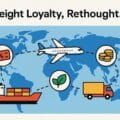
The image for this blog post was created by AI based on the content of this podcast episode.